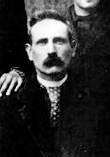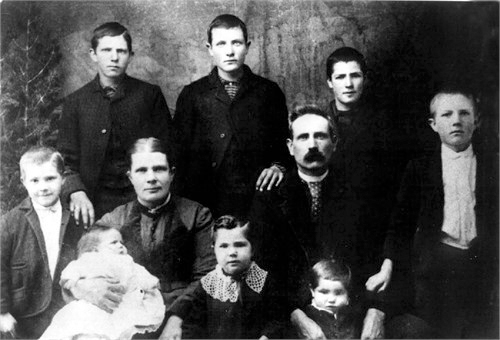
Amos Hyrum Fielding
Born: 17 September 1848 at Wrightington, Lancashire, England Parents: Amos Fielding and Jane Benson
Married: 28 June 23, 1871, Ella Agnes Hobbs at Parowan, Iron, Utah, USA
Died: 6 June 1906 at Pueblo, Pueblo, Colorado, USA
History
Ellen Agnes was the name William Downs Hobbs and his wife Mary Ann Pope gave their seventh child when she was born 23 June 1854. (Children at the time were Mary Ann, deceased, Martha Ann, William T, Mary Anna, Emma Lucy, Tryphena Jane, and Sarah Elizabeth.) Two more, George Brigham and Alice Lavina, would join the family at Hersham, Surrey, England, within a few years. Her parents had joined the Church of Jesus Christ of Latter-day Saints in 1851, and determined to emigrate to Utah. They sailed aboard the ‘Hudson’ and arrived in New York 20 July 1864.
The family crossed the States by train to Laramie, Wyoming, and then by wagon to Salt Lake City in the William Hyde Company, arriving about August 19. They were assigned to settle at Parowan in Iron County.
Here Ellen met Amos Hyrum Fielding, Hyrum was born in England, the son of Jane Benson and Amos Fielding, who was there from Utah, perhaps serving a mission, as he remained in England, sending the mother and child to the USA. These two departed for New Orleans late in 1848 and went to Ellen’s brother Richard’s in St. Louis, where they remained about four years. When Amos came for her about 1852, he had another wife, Jane Southworth, with him. They all started across the Plains to Utah together with Amos and the other woman riding in a carriage and Jane and her four year old son walking most of the way. Jane ended up waiting on them, cooking their meals, which took courage for her to continue under these circumstances. Her knowledge that she was going to Utah to be with the Saints kept her buoyed up.
Ellen left Amos Fielding in Salt Lake City and lived in the care of Heber C. Kimball for a time, then she met a man named Bosnell. They separated within a year. She later married a man named Dalton. Her son and his sons did not get along without quarreling, so she left again.
She lived alone for some time, but peace and real love came to her in John Perkins. He had come from Australia. His first wife had died in Australia. John and Jane were married in March, 1860, and they were congenial and lived happily until his death in 1870. They first lived in the fort at Parowan, and later moved into a home in another part of town. Their third child lived just a very short time.
Jane endured many hardships, and John having come from a big city, knew little of this kind of life, so they had great difficulty earning a living. John passed away at the age of forty-nine years in March 1870. Her daughters, Sarah Jane and Phebe Madora Perkins, were still quite young which made it hard for Jane. With the help of her son, Hyrum, who was then twenty-two years old, she was able to resolutely face the future.
Ellen and Hyrum were married at Parowan 28 June 1871, when Ellen was 17 years old. Later they received their endowments in the St. George Temple, 13 March 1878. Four children were born to them in Parowan: Hyrum William, Thomas Amos, Joseph Oliver, and Ellen Delcena.
In 1879, the Church called a company of saints from Southern Utah to go farther south into the San Juan to start a new colony there. Hyrum and Ellen were among those called, and they left their homes again, always willing to obey the call of their leaders. The company of over a hundred people left the 23rd of October to go over an uncharted trail to an unknown part of the state. Hyrum was at this time 32 years of age, Ellen, 25: and their children 8, 6, 4, and 2 years of age. They packed provisions and what else of clothing and furnishings they could get into their wagon, and started out to their unknown destination.
Some few people, including Ellen’s sister, Sarah Harriman, had previously reached that part of the San Juan where they were to go, but they had gone down across the Colorado River at Lee’s Ferry and into Arizona and up the San Juan to that spot, but now they wanted a shorter route. Silas S. Smith organized the company, Jens Nielsen acted as chaplain.
The people of the company came from Cedar City and Parowan and St. George. They went to Panguich then down across the Escalante Mountains and east to the Colorado River. Their journey was slow and arduous and often times dangerous. Ellen’s brother, George Hobbs, a young unmarried man, acted as one of the four scouts who went ahead and sought out the easiest trails to follow. At last they came to the rim of the Colorado River, and as they looked down over the steep cliffs to the river so far below, it seemed impossible to ever find a way to get to the bottom of the canyon.
They finally found a narrow ravine down which they decided to try to go, but which would take an immense amount of work to make it possible for the wagons. So they set up camp and the men began to work. Silas Smith, back in Salt Lake, got powder and tools to them and they began blasting the first steep cliff away. Then the debris was piled just below to build up a road way there, it was very toilsome and slow. The hill was so steep in some places below that they bored holes in the rocks, put stakes in the holes, and lay poles across the stakes, which were covered with brush and dirt to make steps for the horses to go down.
They called this place, “Hole in the Rock”. Needless to say, some of the men were discouraged, saying it couldn’t be done, and wanting to go back. Hyrum was one who thought they ought to go back. George Hobbs was one of the stout hearted ones, who insisted they go on. Back of them in the Escalante Mountains the snow had been falling until it lay fifteen feet deep. It was now impossible to go back any way, and if they waited for the snow to melt, it would be late spring and they would be out of provisions. So nothing would do now but go on. So they worked on and on. Christmas came and they were still on top. They prepared the best Christmas dinner that their larder could afford and entertained themselves by dancing on a big flat rock to the music of Mr. Perkin’s fiddle.
Another time they had some amusement of a different sort. One of the Redd boys brought in a two year old steer, on which he sold twenty tickets at a dollar a piece. Then they drew lots and the first two winners drew a hind quarter of the steer when it was dressed. The next two winners drew front shoulders, then ribs, neck etc.
The road was ready a few days after Christmas and the wagons were made ready to descend. This is how they proceeded: the wheels of the wagon were cross-locked, then a long stout rope was fastened to the rear end of the wagon, several loops were wrapped around a tree and on the other end, three or four men held the end and let out slack, as the driver of the wagon got in and pulled back on the lines of his team as they went down the steep incline. In this way, they held the wagons back so they didn’t hurtle down at a terrific speed. All watched and waited anxiously as the first wagon went down and breathed a sign of relief and a prayer of thankfulness as it reached the bottom safely. Then with lighter hearts, they prepared to take their turn. As their wagons and men went down, the women and children followed, walking and crawling down the steep sides. At last all were down safely but the last wagon: Joseph Stanford Smith’s (an uncle of the writer).
The other men had all gone down with their wagons, Stanford said to his wife Belle, “I wish I had someone to pull back on the load.” She suggested he tie the extra horse on back of the wagon. (They started with four horses but one had been kicked at a watering hole and had to be shot.) She would take the lines of the extra horse and pull back. They left the three children on the top with instructions to sit still and not move until they came back for them. They started out, Stanford pulling back on the lines of his team and Belle pulling with all her might on the extra horse. Soon the horse was thrown to his side and Belle dragged along on her back. When at the foot of the first steep pitch, Stanford stopped and looked back; Belle was leaning against a tree. He hurried back to her, and as she held one leg up, he rubbed his hands over it to see if it was broken. She reached out and kicked him on the shin, saying, “Does that feel like it was broken?” They laughed, her leg was scratched and bleeding. They looked back up the trail and saw something white on an outcropping brush. He said, “You’ve lost your handkerchief, Belle.” “Handkerchief.” she said, “That’s part of my garment leg.” They reached the bottom without further trouble, carried the children down, and soon were ready to go the others across the river.
Someone, I suppose under the direction of Silas Smith, had had logs cut on the Escalante, tied together, and floated down to those pioneers on the Colorado. They secured these logs, made rafts and ferried across the river. At this place, refuse and rocks from the ravine down which they had come and from a similar place across the stream, had made a sort of dam which made a place where the water ran less swift, so they were able to ferry over without too much hardship. Ten men with poles steered each load across, and kept it from going downstream. A dog got in the current a few feet below this crossing, and it was so swift he could not get out.
The first ones going over, made the crossing on New Year’s Day 1880. The weather had been quite mild, with very little snow.
Then the scouts went ahead to find a suitable place to make their ascent up the other side. This side was not so steep, but the walls were of solid rock. George Hobbs saw some mountain goats, followed them, and they led him out. Then he went back and they began the work of making a road on the goat’s trail. After some time, they were on top again, and they followed along the ridge between the Colorado and San Juan River, on and on over rocks, canyons, sand, until at last, worn and weary, after nearly six months travel, on the 6th of April 1880 they reached their destination. The green trees and willows looked very good to them as they drove down into a little sheltered cove between the high red bluffs on the San Juan. They named the place Bluff City. The place was very small, though, and many of them were disappointed. Some of them, including Ellen and Hyrum, George Hobbs, Stanford Smith, and others went up the river about twenty miles to a place called Montezuma Creek, where the Harriman family had settled earlier. Here the country was broader and there was more room for farming.
It was here, in a wagon box, that Ellen gave birth to her fifth child, a few months after her arrival. John Melvin was born the 13th of September 1880.
Stanford Smith went eastward into Colorado, where some people (gentiles) were making a settlement. Conditions were much more favorable there, so in 1882, Hyrum and family followed on into Colorado, to a place called Mancos. This was about 90 miles east of Bluff City.
Stanford Smith had already taken up a homestead, south of Mancos, and had a ditch built to carry water to his land. The other Mormons coming in took up homesteads over a little ridge to the south, but they couldn’t move right on because ditches had to be built first. Stanford Smith was kind enough to let them build cabins on his property; soon there was a little village of six or seven houses. They also built a log meeting house on his place.
Here Ellen’s sixth child, George Walter, was born in 1883, in the little log cabin. The ditch was finished after a long, hard time. It had to be taken around the foot hills for about five and a half miles from the Mancos River. Then Hyrum built his log house with a lean-to at the back and his family moved into their permanent home. The land was covered mostly with scrub pine, rabbit brush and sage brush, and oak. It was cleared away, crops planted, fences built, and Ellen and Hyrum did their part in building up a new community. This new Mormon village was called Weber.
Ellen did the usual share of work of the pioneer women, carding, weaving, knitting, sewing, all by hand – making soap all things necessary to keep a large family going. The house was added on to as the family increased, and here six more children were born, making twelve children in all. There were: Mary Jane, 1886, Franklin Downs 1887; Alice Constance, 1889; Myrtle, 1891; Delia, 1894 and Leonard, 1896. They all lived to manhood and womanhood except Ellen Delcena (Nellie) who died when Frank was a few weeks old.
Ellen was faithful to her church, attending her meetings and working in the Relief Society. She was a very loving and kind mother and wife, always solicitous of their welfare, and never complaining of the hardships that were hers.
When the baby, Leonard, was a few months old, his father, Hyrum, was taken to a hospital in Pueblo, Colorado, to have a tumor removed from his head. He never returned, dying there some time later.
When Leonard was three years old, Ellen died from the effects of Cholear Morbus, on the sixth of September 1899. She was but 45 years old – young to go and leave such a large family. She was buried in the Mancos cemetery by the side of her daughter.
Source:
1 FamilySearch Memories Amos Hyrum Fielding
2 FamilySearch Memories Jane Benson
3 FamilySearch Memories Ellen Hobbs
Written by their daughter-in-law Lydia Hammond Fielding (with updates and clarifications by David Walton, Bluff Fort CSM, 2015)
Family Search:
Amos Hyrum Fielding on FamilySearch