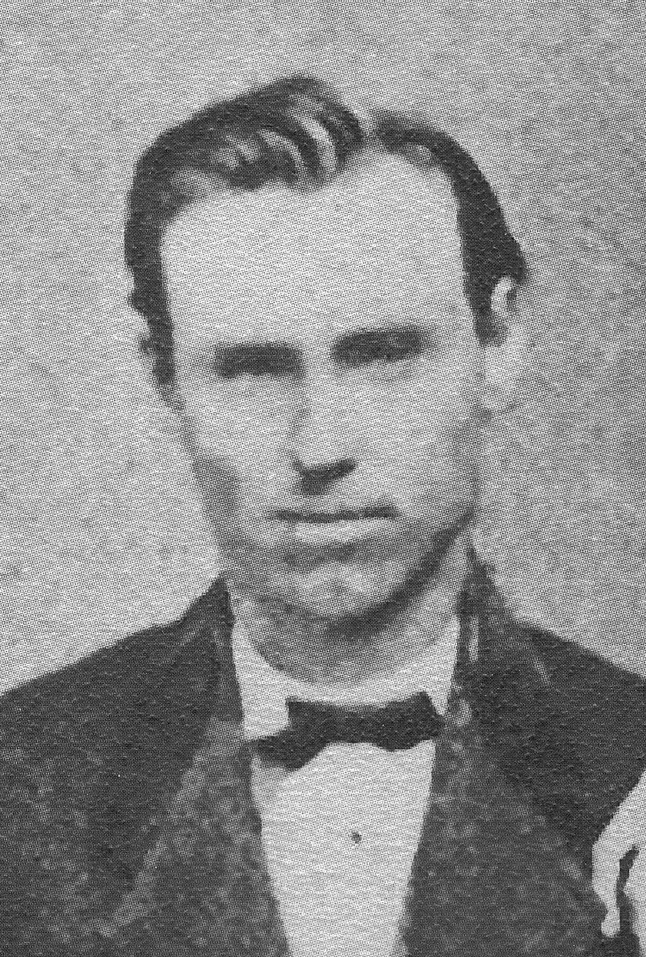
Joseph Stanford Smith
History
Joseph Stanford Smith (called Stanford) was born on June 23, 1850, in Tipton, Staffordshire, England to Joseph Hodgetts Smith and Maria Stanford Smith. He was the youngest of their three children, and the only son. His parents had converted to the Church of Jesus Christ of Latter-day Saints prior to his birth. In 1854 Church leaders in the British Isles counseled all Church members to immigrate to Utah. In obedience to this counsel, Stanford’s family left England on April 22, 1855, aboard the Curling, a ship named after its captain, Samuel Curling, who was remembered as a man who was friendly to the 581 English Mormons who were aboard his vessel.
Sailing across the Atlantic was no doubt a great adventure for young Stanford. In later years he could still recall one particular moonlit night when the Curling seemed to be surrounded by an army of fish – perhaps dolphins – that playfully followed the boat. As the fish surfaced, the moonlight reflected off their fins and tails, causing the water to sparkle and shine to the delight of the passengers who stood watching on deck. A kind man lifted Joseph to his shoulders so that he would be able to see the amazing site.
The Curling arrived in New York on May 27, 1855. From there the Saints proceeded by railway to Pittsburgh and by steamboat up the Mississippi, passing through St. Louis on their way to Atchison, Kansas. i Stanford’s family purchased two yoke of oxen, a yoke of cows, and other necessary supplies before beginning the long trek to the Salt Lake Valley during the hot summer months. Stanford’s older sisters, Emma, who was 13, and Ann, age 11, both walked the entire way. His grandmother, Letitia Stanford, however, was in poor health and so rode in the wagon. She was determined to reach the valley alive, having declared to her concerned family that she would “neither be food for the sharks nor for the prairie wolves, but [that] she knew that she would be able to reach the Valley.” ii Her indomitable spirit was rewarded the day the wagon reached the mountains surrounding Salt Lake and the wagon cover was lifted for her to see the view of the valley below. With a happy sparkle in her eye, she affirmed that she was now ready to die, which she did just a few days later.
Looking back on the experience of crossing the plains, Stanford remembered one exciting day when the men riding in advance of the wagon train came hurriedly back to warn the pioneers of a buffalo stampede that was headed right for them. As quickly as they could, the men faced their wagons northward, so as to create space between the wagons for the buffalo to pass through. In a powerful rush, the buffalo stream went through the wagon train, snorting and bellowing as they went by. Thankfully, no one was injured during their passing, but the incident left an impression upon young Stanford’s mind. His father killed one of the cows and her calf that were lagging behind and the pioneers thankfully feasted on the meat for many days afterward.
The Smith family arrived in the Salt Lake Valley in October, and were soon sent to settle in Iron County. Stanford’s father was knowledgeable on the manufacturing process of pig iron, which process was being developed in Cedar City at the time. Growing up in Cedar City meant Stanford did not have much opportunity for formal schooling. Most of what he learned, he learned through hands-on experience. He helped his father with the farm work and chores, and when he got older he shared in guard duty and road building. When the telegraph was invented he and his father helped haul telegraph lines for the Deseret Telegraph Company.
Source:
Researched and written for the Hole-in-the-Rock Foundation by:
C.S.M. Jones LLC, Family Heritage Consulting.
Bibliography
1880 United States Federal Census, Bluff City, San Juan, Utah. Roll: 1337; Family History Film: 1255337; Page 345A; Enumeration District: 105. Digital image on ancestry.com (accessed Nov. 9, 2010).
Fielding, Lydia Hammond. “Biography of Joseph Stanford Smith, Came to Utah 1855.”
Unpublished history from the files of the Daughters of Utah Pioneers, Salt Lake
City, UT.
Jenson, Andrew, comp. Church Chronology: A Record of Important Events Pertaining
to the History of the Church of Jesus Christ of Latter-day Saints, comp. Salt Lake City, Utah: Deseret News, 1914. http://contentdm.lib.byu.edu/cdm4/document.php?CISOROOT=/BYUIBooks&CISOPTR=1067&REC=1 (accessed Nov. 2, 2010).
Jones, Raymond Smith. “Last Wagon Through Hole-in-the-Rock.” Desert Magazine, June 1954, 22-25.
“State Pioneer Celebrates 90th Birthday.” Pioneer, June 23, 1940. Courtesy of the
Daughters of Utah Pioneers, Salt Lake City, UT.
RootsWeb.com. “The Limbs and Branches of the Smith Family Tree.”
http://worldconnect.genealogy.rootsweb.ancestry.com/cgi-bin/igm.cgi?op=GET&db=tsmith&id=I101121 (accessed Nov. 3, 2010).
Utah State Office of Education, BYU-Public School Partnership, and Utah Education
Network. “Pioneer 1848-1868 Companies.” Heritage Gateways.
http://heritage.uen.org/companies/Wc7b9be2458f36.htm (accessed Nov. 3, 2010).
i Andrew Jenson, comp., Church Chronology: A Record of Important Events Pertaining to the History of the Church of Jesus Christ of Latter-day Saints, Salt Lake City, Utah: Deseret News, 1914, 53. Available digitally through L. Tom Perry Special Collections, Harold B. Lee Library, Brigham Young University, Provo, UT. http://contentdm.lib.byu.edu/cdm4/document.php?CISOROOT=/BYUIBooks&CISOPTR=1067&REC=1
The life history of Joseph Stanford Smith written by his step-niece, Lydia Fielding Hammond, indicates that the Smith family ended their steamboat travels in St. Louis, instead of just passing through on the way to Kansas. But it is more likely that they stayed on the steamboat to Kansas with the rest of the Mormon travelers, and from there purchased the ox team and wagon needed to cross the plains. See Lydia Hammond Fielding, “Biography of Joseph Stanford Smith, Came to Utah 1855,” unpublished manuscript from the files of the Daughters of Utah Pioneers, Salt Lake City, UT.
ii Lydia Hammond Fielding, 2.
iii RootsWeb.com lists two baby girls who died at birth in 1872. However, Mary Ann, listed as born in California, seems not to match with family records compared to Ellen, born 29 Sept., 1872 in Cedar City. Other children are listed which likewise seem questionable given their dates and places of birth, namely Arabella Smith (1881 in California) and Joseph S. Smith (in 1883 in California). There is no mention in other sources of the Smith family ever having lived in California.
iv Lydia Hammond Fielding, 3.
v Raymond Smith Jones, “Last Wagon Through Hole-in-the-Rock,” Desert Magazine, June 1954, 24. Jones was a grandson of Stanford Smith. His engaging narrative of Stanford and Arabella’s dangerous descent down the Hole-in-the-Rock is based upon Stanford’s telling of it to family members prior to his death.
vi Raymond Smith Jones, 24.
vii Agnes Eardley’s marriage to Stanford is hard to trace. It is mentioned only in Lydia Fielding Hammond’s history of Stanford Smith, but does not appear in other sources.
Family Search:
Joseph Stanford Smith on FamilySearch