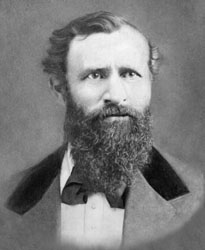
Silas Smith Jr.
Born: 10 July 1853 at Parowan, Iron, Utah, USA
Died: 19 January 1911 at Rexburg, Madison, Idaho, USA
History
After joining the Church of Jesus Christ of Latter-day Saints, James Williamson came to America to prepare a home for his family. When Betsy was about three years old, he sent for them. On 25 May 1856 Ann Allred Williamson and her six living children sailed from Liverpool, England, together with nine hundred others, and landed in Boston, Massachusetts, on the 28th day of June having spent five weeks on the ocean. They all proceeded to Iowa City where, in late July, they joined the handcart company led by Edward Martin.
It was an error of judgment to send this company over the plains so late in the season. Early in the journey many of the handcarts broke down, causing additional delay. The story of this handcart company is a very sad and pitiful one of men and women pushing and pulling the handcarts and carrying little children, and helping the aged and the feeble travel on day after day in hunger and misery. Betsy sometimes rode on the handcarts, and she was sometimes carried by her uncomplaining brothers and sisters, for she was only a little over three and one-half years of age.
Provisions became low, and they had to be put on rations which gradually became less and less as the days went by until they were allowed only one spoonful of flour per person per day. The immigrants grew hungrier and weaker day by day.
Unable at last to pull their loads, they were compelled to lighten them by throwing away some of their bedding and clothes that would be needed so badly before long, as it was getting colder every day. The captain would come and throw away things that he thought they could get along without. Betsy’s mother was bringing a few things that were relics from her old home: a metal lion and some cups and saucers. These highly prized items the captain threw away. That night after dark one of the girls retrieved them and hid them in her clothing she kept them the rest of the way. The china cups and saucers can now be seen in the Daughters of the Utah Pioneers’ Museum in Salt Lake City.
Death after death occurred, so that the trail of Ole company could almost be traced by the new graves. The snow fell, and the bitter, cold winds blew on the worn and weary travelers, but they dared not stop lest their fate be even worse. They had crossed the river wading in the ice-cold water, and were trying to set up camp in a driving snow storm between the Sweetwater and the Platte rivers. They were so weak and cold that they had trouble in trying to drive the stakes into the frozen ground to pitch their tents. They had just about give up all hopes and had settled down in their bleak surroundings, which they called Martin’s Ravine; it became a cemetery before they left it. It was here that the relief party sent out by Brigham Young found them late in October. They reached Salt Lake City a month later, having lost one-fourth of their number, who had died and been buried on the plains. Betsy’s family was very fortunate, for they all arrived safely and gave thanks unto God.
In Salt Lake they were met by her father, James Williamson, who had already paid for their transportation across the plains by ox team. He took them to Paragonah, in the southern part of Utah, to make their home. Here Betsy grew to womanhood, and she told many stories of how the Indians would come to their home begging for food, and how careful they would have to be to clean up after Ute Indians had been in the house, on account of the lice which the Indians carried.
Betsy was married to Silas Sanford Smith, Jr., son of Silas Sanford Smith and Clarinda Ricks, in the Endowment House in Salt Lake City, 3 November 1873. They carne a distance of 250 miles by ox team, accompanied by her mother, and returned the same way. In Paragonah, they built their first home, a two-room adobe house which was used by several different families for over eight years. Then it was torn down and replaced by a modern brick home.
While they lived in Paragonah, their first two children were born: Clarinda Ann, born 2 May 1876; and Silas Sanford (Ill), born 4 October 1878.
During the late 1870’s one or the projects closest to Brigham Young’s heart was the colonization or southeastern Utah. It was fast becoming a hangout for outlaws, unfriendly Indians and non-Mormon stockmen. The Mormon leader was justifiably concerned about his neighbors across the Colorado River to the southeast. Many of them lived by raiding and pillaging the Mormon settlements west or the Colorado, One writer stated that losses to the raiders in sheep, cattle and horses were established in more than a million dollars in one year. Mormon leaders knew that taming the southwest corner would be difficult.
Source:
Originally written in the 1940’s by Don Samuel Smith, son of Betsy Williamson and Silas Sanford Smith, Jr.; revised in 1963 by Kathryn Pincock Seely, granddaughter of James Albert Smith. (paragraphs about the Hole in the Rock Expedition added in 1997 by Kathryn.) .
Sources:
1 FamilySearch Memories Amos Hyrum Fielding
2 FamilySearch Memories Jane Benson
3 FamilySearch Memories Ellen Hobbs
Family Search:
Silas Smith Jr. on FamilySearch