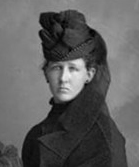
Angeline Harris Hyde
Born: 4 November 1834 at Bertrand, Berrien, Michigan, United States
Parents: John Harris and Lovina Eiler
Married: William Hyde, 13 Sep 1852 at San Bernardino, San Bernardino, California
Died: 4 February 1893 at Nephi, Juab, Utah, United States
History
Angeline was the third child of John and Lovina Eiler Harris. traveled with them to Utah, giving up their plans to settle in Oregon. The family was called to help settle San Bernardino, California, in 1851, and lived there for nearly seven years. At nearly age eighteen, she married another San Barnardino pioneer, William Hyde. When the LDS Church called the members back to Utah in 1857, most of her family answered by making the move.
Her husband intended to take a second wife, and, so, she remained with her two small children in Minersville near Beaver, while he continued north to Salt Lake City, where he married Mary Ann Green 7 April 1858. He helped Mary Ann establish a home in Harrisville, Weber County.
Between the two wives, William had thirteen children, eight with Angeline (at Minersville and then in Salt Lake City) and five with Mary Ann.
Learning of the call of settlers to San Juan, William set about to join the group intending to establish a store and trading post at Fort Montezuma. Because of the additional preparations needed to gather supplies and wagons to transport them, the Hyde family was not with the original company in 1879, but left Salt Lake on June 27, 1880, with hired teamsters and guards. The written account of one unidentified hired hand tells of their leaving half of their supplies at Escalante and blazing a new trail by way of Halls Crossing. [This account raises several questions. From all documented accounts, Halls Crossing was not established and the ferry not moved from the Hole-in-the-Rock crevice to Halls Crossing until early in 1881. Either Halls Crossing was operational much earlier than numerous sources indicate, or the blazing of the trail to Halls Crossing mentioned above by Hyde’s hired hand took place during a later trip. (Note added by Lamont Crabtree)]
The group arrived at Fort Montezuma on September 18th, making the trip from Salt Lake City to Fort Montezuma in nine days short of three months. They immediately went to work building a substantial cabin and later built the first store in San Juan County. It was also called the Indian trading post. Hyde went on to build four trading posts.
The Hyde family had been asked by Church leaders to establish a wool depot, and to help the Navajos market their wool. The Hyde family not only built the store, but they rigged up a cable across the San Juan River with a boat attached, so the Navajo people could cross the river and do business without having to swim. This boat-cable system became a luxury to the Indians, and a great plaything for the Hyde children. William’s son, Ernest, enjoyed going hand over hand out the cable until he was over the middle. He would drop into the river and swim back. During November of 1880, Harriet Parthenia Hyde, affectionately called Feen, or Feenie, by the settlers, was given the assignment of teaching school at Montezuma.
William Hyde and others built water wheels, and placed them in the San Juan River, to lift water into the irrigation ditches.
During the spring of 1881, a young Ute man, the son of Sanop, fell in love with Parthenia. Eventually Sanop approached William Hyde and asked for Parthenia, to be a wife for his son. William refused, and Sanop threatened to kill him, but William was firm. Sanop backed down, but it was a severe insult to the Indian. In Indian Culture, he had acted properly and respectfully, as per Ute Indian custom. She married Bluff’s blacksmith, Amasa Barton, 28 November 1884 at St. George, Washington, Utah.
William served as the branch president in Montezuma and was released in 1883. His home was the largest and best home in Montezuma, but during the floods of 1884 it was washed away, and he soon thereafter William moved his second family to Colorado. Angeline remained in Bluff, and assisted her daughter, Harriet, with the births of Harriet and Amasa Barton’s first two children. She was at Rincon, when Amasa was killed by two Navajo Indians in a trade gone bad.
Angeline did not return to her husband. She eventually left Bluff and established herself in Nephi, where she died in 1893.
Source:
by David L. Walton and Dallan Simper
Family Search:
Angeline Harris Hyde on FamilySearch